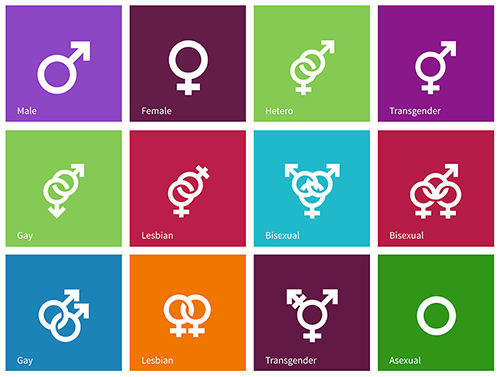
To understand more about gender identity, we have added these definitions from the LGBTQIA Resource Center and Wikipedia.
Assigned gender at birth (AGAB) is a term that refers to the sex or gender assigned to people when they are born. As people are assigned a gender at birth in regards to their physical characteristics, an assigned gender does not account for one’s internal gender identity.
Bottom Surgery refers to any gender affirming surgeries performed on the genitalia.
- In transmasculine individuals, this may be a hysterectomy (removal of the uterus), and/or a oophorectomy (removal of the ovaries). A penis can be constructed through metoidioplasty or phalloplasty, and a scrotum through scrotoplasty
- In transfeminine individuals, this may be a penectomy (removal of the penis), orchiectomy (removal of the testicles), vaginoplasty (construction of a vagina), and/or a vulvoplasty (construction of a vulva)
Cisgender is an adjective that refers to individuals who identify the gender assigned to them at birth. Cisgender people may have any sexual orientation or gender expression.
Detransitioning (sometimes also known as re-transitioning) is the cessation of transgender identity and/or a transition to a different gender, often to one’s natal gender.
Facial surgery refers to any gender-affirming surgery underwent on the face. There exists facial masculinization and facial feminization.
Gender dysphoria refers to the distress a person experiences from a mismatch between their internal gender identity and their gender assigned at birth. People who suffer from gender dysphoria may transition in order to alleviate this distress.
Gender Expression: How one expresses oneself, in terms of dress and/or behaviours. Society, and people that make up society characterize these expressions as “masculine,” “feminine,” or “androgynous.” Individuals may embody their gender in a multitude of ways and have terms beyond these to name their gender expression(s). Typically, a person’s gender expression is thought of in terms of masculinity (a tomboy, a butch lesbian, a drag king) or femininity (an effeminate male, a ‘femboy’, a drag queen), but an individual’s gender expression may incorporate both feminine and masculine traits, or neither. One may express their gender through clothing, behaviour, hair styling, voice, etc. It is not necessarily related to one’s gender identity.
Gender Identity: A sense of one’s self as trans, genderqueer, woman, man, or some other identity, which may or may not correspond with the sex and gender one is assigned at birth.
Gender Non conforming (GNC): Adjective for people who do not subscribe to societal expectations of typical gender expressions or roles. The term is more commonly used to refer to gender expression (how one behaves, acts, and presents themselves to others) as opposed to gender identity (one’s internal sense of self).
Gender Queer: A person whose gender identity and/or gender expression falls outside of the dominant societal norm for their assigned sex, is beyond genders, or is some combination of them.
Going ‘full-time’ refers to the act of living everyday life as one’s identified gender. People who go full-time may or may not pass, and may or may not keep their transgender identity a secret.
Going ‘stealth’ refers to the act of living as one’s identified gender without revealing oneself to be transgender. In some countries, being stealth may be a safety necessity, due to health, safety, and wellbeing risks of being openly transgender.
Hormone replacement therapy (HRT) is a medical treatment that replaces the primary sex hormones in one’s body, in order to develop the secondary sex characteristics of the opposite sex.
- Individuals seeking masculinizing HRT are prescribed the male sex hormone testosterone
- Individuals seeking feminizing HRT are prescribed the female sex hormone oestrogen
Non-binary is a term that refers to a gender identity described as neither entirely male nor female (not one of the two binary sexes). Non-binary people may suffer from gender dysphoria, and may consider themselves transgender. Non-binary people may have any sexual orientation or gender expression.
Passing refers to the perception and recognition of trans people as their desired gender identity by outsiders who may not know they are transgender. For many trans people, passing is a very important aspect of their transition often seen as an ‘end goal’. Passing can greatly alleviate gender dysphoria. Failure to pass can cause serious repercussions for trans people’s psychological well-being and safety, including but not limited to: poor mental health, discrimination, increased barriers to medical care, harassment, fetishization, ostracization, increased risk of homelessness, and targeted violence due to increased visibility of one’s transgender status.
Pronouns: Linguistic tools used to refer to someone in the third person. Examples are they/them/theirs, ze/hir/hirs, she/her/hers, he/him/his. In English and some other languages, pronouns have been tied to gender and are a common site of misgendering (attributing a gender to someone that is incorrect.)
Queer: One definition of queer is abnormal or strange. Historically, queer has been used as an epithet/slur against people whose gender, gender expression and/or sexuality do not conform to dominant expectations. Some people have reclaimed the word queer and self identify in opposition to assimilation (adapted from “Queering the Field”). For some, this reclamation is a celebration of not fitting into social norms. Not all people who identify as LGBTQIA use “queer” to describe themselves. The term is often considered hateful when used by those who do not identify as LGBTQIA.
Sex: a medically constructed categorization. Sex is often assigned based on the appearance of the genitalia, either in ultrasound or at birth.
Top Surgery refers to any gender affirming surgeries performed on the breasts.
- In transmasculine individuals, this may be a double mastectomy (removal of breast tissue), and/or a ‘male chest reconstruction’
- In transfeminine individuals, this may be a breast augmentation.
Transgender is an adjective that refers to individuals who identify with a gender that differs from the one assigned to them at birth. Transgender people may have any sexual orientation or gender expression.
Transition: Transitioning is the process of taking steps to live as one’s true gender identity. Transitioning is different for each individual and may or may not involve medical interventions like taking hormones or having surgery. Some people may not choose to transition in certain ways for a variety of reasons. The extent of someone’s transition does not make that person’s gender identity any less or more valid.
Transitioning may include socially transitioning, such as going by certain pronouns or going by the Lived Name that affirms one’s gender identity. Transitioning may involve making changes to one’s physical appearance, such as wearing certain clothing, wearing one’s hair in a different style or length, or more complexComplex Use a C for "Complex" when you have a multifaceted or evolving gender identity. changes such as medically transitioning through hormones or surgery. Transitioning can also involve changing legal documents to match one’s authentic sense of self.
Voice surgery refers to a surgical treatment that allows for the masculinization or feminization of one’s vocal pitch.
- Transfeminine people can undergo voice surgery to surgically increase their pitch range
- Transmasculine people very uncommonly undergo voice surgery, as masculinizing HRT (testosterone) often lowers voices to a cisgender male pitch. Irrespectively, vocal masculinization surgery can be undergone to surgically decrease their pitch range.
Voice therapy (or ‘voice training‘) refers to a non-surgical gender-affirming treatment for the masculinization or feminization of one’s voice.
- Transfeminine people will not experience any impact on voice pitch from feminizing hormone therapy (unless their natal puberty was sufficiently blocked), so voice training is very often undergone in order to learn how to speak in a higher and more feminine register
- Transmasculine people, on the other hand, will experience a marked lowering in pitch from masculinizing HRT (testosterone) to an often cisgender male level, so vocal masculinization training is uncommon outside of those who have not undergone masculinizing HRT. Irrespectively, vocal masculinization training can help one learn to speak in a lower and more masculine register.
This information is kept up to date as well as possibly. However, due to the frequently changing ‘terminology of the day’, it may be out of date or cause offence to someone. Please comment and suggest corrections or changes as appropriate.